
Hotel flooring carries more design responsibility than almost any other commercial floor. Lobbies and public spaces are the first thing a guest sees, so the floor is part of the brand, while still handling luggage wheels, constant traffic, and wet areas near pools and spas. The materials that work in hospitality deliver both, and can be refinished rather than replaced when a property renovates.
In most commercial buildings the floor is infrastructure. In a hotel it is part of the product.
A guest forms an impression of a property within seconds of entering the lobby, and the floor occupies more of that view than almost any other surface. At the same time it has to survive rolling luggage, event traffic, spills, and cleaning at all hours, in a building where taking a space out of service costs revenue directly.
That combination of design responsibility and hard use is what sets hospitality flooring apart.
The lobby is a design decision
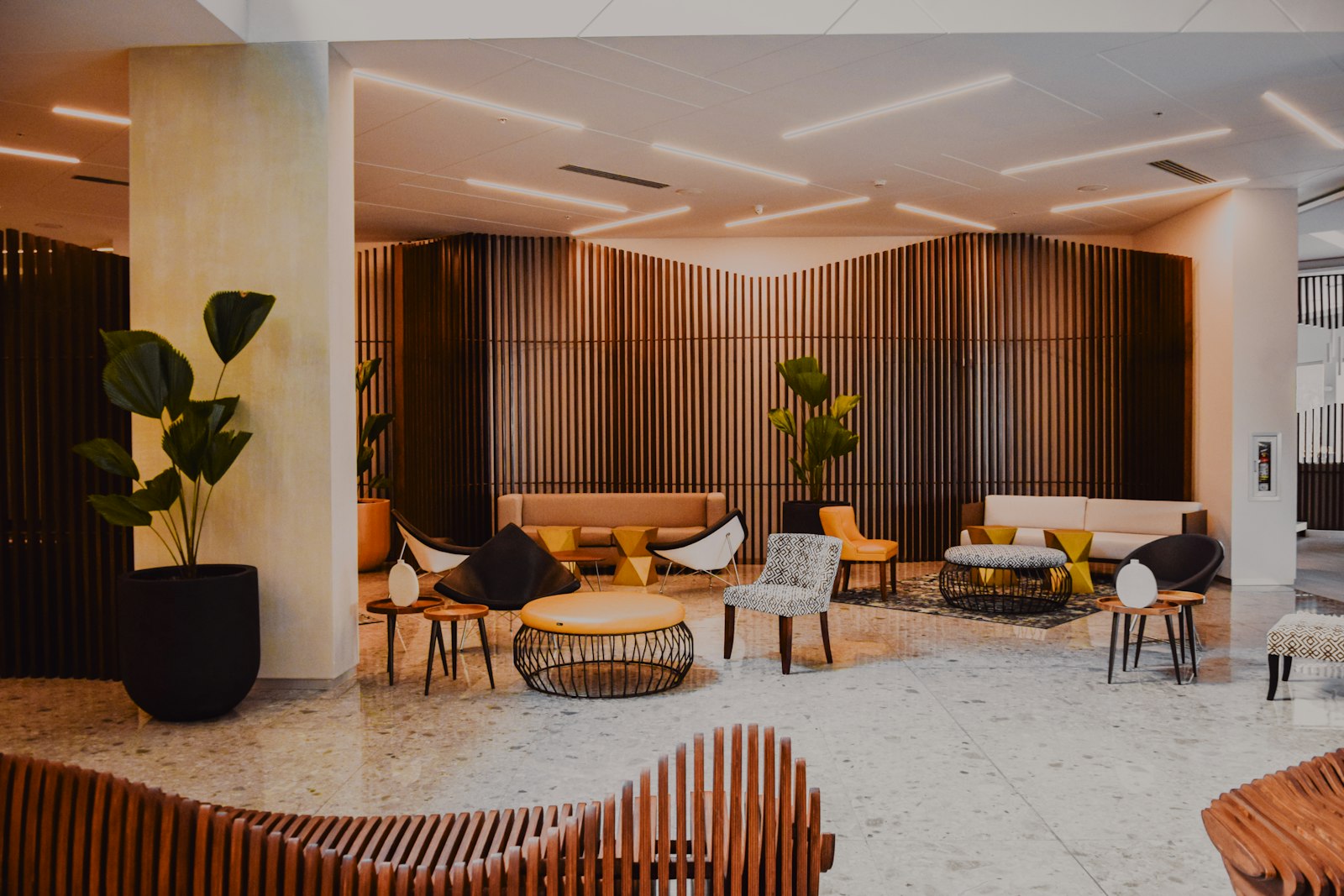
Hotel lobbies and public spaces are where properties invest, because they establish the brand impression the rest of the stay is measured against. Casinos, resorts, and convention hotels push this furthest, but it applies across the segment.
Flooring contributes in ways applied finishes cannot. A poured terrazzo floor can carry custom colors, patterns, and inlaid graphics as permanent parts of the surface, which means the design element does not wear, peel, or date the way an applied treatment does. Tile and natural stone carry design just as fully. Large-format porcelain, mosaics, and custom patterns give designers a very wide range of color and texture, and stone brings a character unique to each piece. Many signature lobbies combine all three.
The practical constraint is that these spaces also see the heaviest traffic in the building, so whatever carries the design has to survive it.
What hospitality floors have to survive
Rolling luggage. Wheels concentrate load along the same paths from entrance to elevator, day after day, so the floor and its installation both have to be specified for that load.
Continuous operation. Hotels do not close. Cleaning happens around guests, and any flooring work has to be phased around occupancy.
Event and banquet traffic. Function spaces see surges, rolling equipment, and setups and teardowns that treat floors roughly.
Food and beverage. Restaurants and bars bring spills, grease, and frequent cleaning.
Wet areas. Pools, spas, and locker areas combine constant moisture with bare feet, which makes slip resistance a safety and liability question rather than a preference.
Wet areas call for tile specified to the full standard
Pool decks, spa areas, and locker rooms deserve deliberate specification rather than a default selection.
Designers and architects typically specify tile as meeting ANSI A137.1, the American national standard for ceramic tile. Slip resistance, measured as dynamic coefficient of friction or DCOF, gets most of the attention, and the test method and product use classifications indicate the conditions a given product is suited to. But DCOF is only one of the requirements in the standard. A137.1 also covers properties such as breaking strength, bond strength, dimensional tolerances, and resistance to crazing and freeze/thaw cycling, and a tile has to meet every requirement that applies to it. A tile appropriate for a dry corridor may be entirely wrong for a wet pool deck, and a good DCOF value alone does not make a tile right for the job.
Getting this right at the specification stage is far cheaper than addressing it after a property opens.
Renovation cycles drive the real cost
Hotels renovate on a schedule. Property improvement plans, brand standards, and competitive pressure mean public spaces are refreshed periodically whether or not the flooring has failed.
A floor that has to be demolished and replaced at every renovation adds cost and downtime to each cycle, which is why hospitality owners increasingly weigh finishes on total cost of ownership rather than installed price. A floor that can be refinished in place, or that is durable and neutral enough to survive a design refresh around it, reduces both.
Tile and natural stone can stay in place through a refresh for as long as the design holds. Terrazzo can also be ground and re-polished to restore its appearance, and because the design is in the material rather than applied to it, a floor installed in one renovation cycle can often carry through several. The National Terrazzo and Mosaic Association publishes guidance on maintaining and refinishing both new and existing floors.
Where materials fit in a hotel
- Lobbies and public circulation: terrazzo, tile, and natural stone, where design and durability both matter
- Guest bathrooms: tile, specified to ANSI A137.1 for the conditions of the space
- Pool, spa, and locker areas: tile specified to ANSI A137.1, including slip resistance for wet conditions
- Restaurants and bars: tile, stone, or resilient depending on the design and service intensity
- Guest rooms and corridors: carpet or resilient, chosen for acoustics and comfort
- Back-of-house: polished concrete or resilient
Hospitality flooring from David Allen Company
Hospitality is among the sectors David Allen Company works in most, including Caesars Virginia, one of our most ambitious projects to date at over 100,000 square feet of tile, stone, and brick, and the Atlantic Restaurant and Oak and Star Tavern at Universal Studios.
Our terrazzo teams have earned more National Terrazzo and Mosaic Association Honor Awards for quality workmanship than all other terrazzo contractors in the Southeast combined, with more than 50 million square feet of terrazzo installed and a comparable record in tile. Because we install terrazzo, tile, stone, underlayment, carpet and resilient flooring, and polished concrete, a property using several materials can keep the whole scope with one contractor.
Frequently asked questions
What flooring is best for a hotel lobby?
Lobbies need materials that carry the design and survive heavy traffic, which usually means terrazzo, tile, or natural stone. The choice depends on the design direction and how much custom color and pattern the concept requires.
What flooring should be used around a hotel pool?
Tile is standard, specified to ANSI A137.1 for wet conditions. Slip resistance (DCOF) is one of the requirements in that standard, and manufacturers publish ratings and classifications indicating which products suit wet areas.
How does hotel flooring hold up to luggage wheels?
Rolling luggage concentrates load along the same paths repeatedly, so the material and its installation both matter. Terrazzo, tile, and natural stone all perform well under luggage traffic when installed to industry standards.
Can hotel flooring be updated during a renovation without full replacement?
Sometimes. Terrazzo can be ground and re-polished to restore its appearance rather than replaced, which can allow a floor to carry through multiple renovation cycles while other finishes change around it.
Can a hotel stay open during flooring work?
Generally yes, with phasing by area and off-hours scheduling. Coordination around occupancy and events is usually the main planning consideration.