
Most commercial tile failure is traced to conditions beneath the tile rather than the tile itself. Substrate movement with no movement joints to absorb it, moisture in the slab, inadequate bond from poor mortar coverage, and substrate flatness out of tolerance account for the great majority of cracked, hollow, loose, and lippaged floors. Almost all of it is decided before the first tile goes down.
Tile is a rigid, brittle finish bonded to a substrate that moves. That is the core tension in every tile installation, and nearly every failure is a version of it.
The tile is rarely the problem. Porcelain and ceramic tile are harder and more dimensionally stable than almost anything else in a commercial building. When a tile floor fails, the cause is usually in the layers the owner never sees.
Substrate movement with nowhere to go
Concrete moves. It shrinks as it cures, expands and contracts with temperature, and deflects under load. A building frame moves too.
Tile bonded rigidly across a substrate that moves has two options: the assembly accommodates the movement somewhere, or something cracks. Movement joints are how the assembly accommodates it, placed at the perimeter, at changes in substrate material or plane, over substrate joints, and at intervals across large fields.
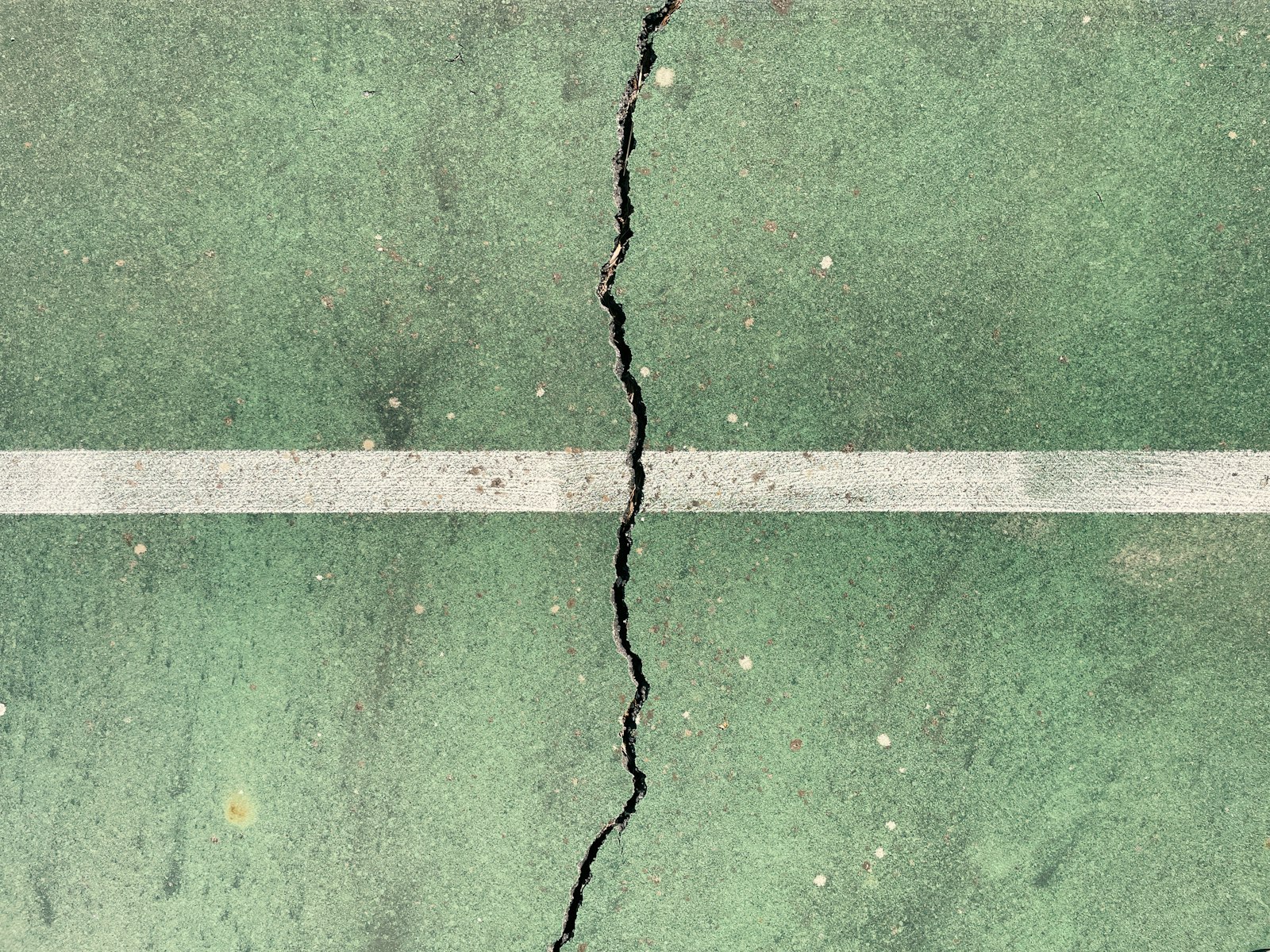
When movement joints are omitted, placed too far apart, or filled with grout instead of a flexible sealant, the stress has nowhere to release and it releases through the tile. This shows up as cracking in straight runs, tenting, and tile popping loose along the field.
A related problem is the control joint in the slab below. A joint in the concrete is there because the concrete is expected to move at that line. Tiling over it without carrying a movement joint up through the tile means that movement will still happen, and it will travel through the tile.
Moisture in the slab
Moisture is the failure mode that takes the longest to show up and is the most expensive to fix.
Concrete holds water. A slab that has not dried enough, a slab on grade with no vapor retarder beneath it, or a slab in a building where groundwater finds its way in all carry moisture that has to go somewhere. Under a tile floor with a bonded setting bed, the path out is through the assembly.
The results are bond failure, efflorescence coming up through grout joints, discoloration, and in the worst cases a floor that releases in sheets. Moisture testing before installation is the only way to know what the slab is doing, and it is one of the first things that gets skipped under schedule pressure.
Bond failure and mortar coverage
Tile holds because mortar bonds it to the substrate across its back. When that coverage is incomplete, the tile is supported in some places and hollow in others.
Hollow spots are weak points. Under point loads, rolling traffic, or a dropped object, tile over a void cracks where solid tile would not. Large format tile is especially unforgiving here, because a bigger tile spans more unsupported area and leverages any void into a crack.
Coverage problems come from mortar that has skinned over before the tile was set, from spot bonding instead of full troweling, and from notched trowels too small for the tile being installed. None of these are visible once the floor is grouted, which is why coverage gets verified during installation by pulling tiles, not after.
Substrate flatness and lippage
Lippage is the height difference between adjacent tiles. It is a tripping hazard, it is where chipping starts, and it is the most common complaint on large format tile floors.
The underlying cause is usually substrate flatness. A substrate out of tolerance cannot produce a flat tile floor, because the installer is either following the substrate’s contours or trying to make up the difference in mortar thickness, and mortar thickness variation introduces its own problems.
The Ceramic Tile Education Foundation’s guidance on lippage hazards covers how flatness tolerance, tile size, warpage, and joint width interact, and why the fix is almost always correcting the substrate rather than compensating during installation. On a slab out of tolerance, a self-leveling underlayment placed before tiling is the conventional remedy, and it has to be in the budget and the schedule from the start.
Slip resistance specified after the fact
Not all tile failures are structural. A floor that is beautiful, flat, and firmly bonded still fails its purpose if people slip on it.
Slip resistance is measured by dynamic coefficient of friction under ANSI A326.3, and the standard sets different minimums for interior dry, interior wet, and exterior wet conditions. Tile that is appropriate for a dry interior corridor may be entirely inappropriate at an entrance. Coverage of ANSI A326.3 in TileLetter, the National Tile Contractors Association’s publication, lays out how the categories work and why the selection has to match the actual use condition.
The failure here is specifying a tile for appearance and discovering the slip resistance problem after the floor is in.
What prevents nearly all of it
| Failure | What prevents it |
|---|---|
| Cracked or tented tile | Movement joints at the perimeter, over substrate joints, and across large fields, filled with flexible sealant |
| Bond failure from moisture | Moisture testing before installation, and addressing results before tiling |
| Hollow and cracking tile | Verified mortar coverage, correct trowel size, mortar not skinned over |
| Lippage | Substrate flatness within tolerance, corrected with underlayment where it is not |
| Slips | Tile selected to the DCOF category that matches the actual wet or dry condition |
The pattern in that column is consistent: all of it is decided before installation, and all of it costs far less to address on paper than in the field.
Commercial tile from David Allen Company
David Allen Company installs commercial tile as part of its specialty flooring services, alongside terrazzo, polished concrete, stone, underlayment, and carpet and resilient flooring, for commercial, institutional, and government projects.
Because the same contractor also installs the underlayment on many of these projects, substrate preparation and tile installation are coordinated within one scope rather than negotiated between two subcontractors. On a floor where flatness and moisture are the difference between a thirty-year installation and a callback, that matters.
Request an estimate, or explore our project portfolio.
Frequently asked questions
Why do commercial tile floors crack?
Most cracking comes from substrate movement with no movement joint to absorb it, or from tile set over a void where mortar coverage was incomplete. The tile itself is rarely the weak point.
What causes tile to come loose from the floor?
Bond failure, usually from moisture in the slab, from mortar that skinned over before the tile was set, or from spot bonding instead of full coverage across the back of the tile.
How do you prevent lippage in a tile floor?
By getting the substrate flat within tolerance before tiling. Where the slab is out of tolerance, a self-leveling underlayment corrects it. Lippage cannot be reliably fixed by varying mortar thickness during installation.
Do tile floors need movement joints?
Yes. Movement joints belong at the perimeter, at changes in substrate material or plane, over joints in the substrate, and at intervals across large tile fields. Filling them with grout instead of flexible sealant defeats their purpose.
Can you tile over a cracked concrete slab?
It depends on whether the crack is stable or still moving. A moving crack will telegraph through the tile unless the assembly is designed to isolate it. The crack has to be evaluated before the floor is specified, not after.