
Airport flooring has to survive constant foot traffic and rolling luggage, support wayfinding across large and confusing spaces, tolerate cleaning at all hours, and last for decades in a building that never closes. Terrazzo is common in main terminal circulation because it handles rolling loads, allows color paths and graphics to be built into the floor, and can be refinished in place rather than replaced.
An airport terminal is one of the most demanding flooring environments in commercial construction. It operates continuously, it cannot close for renovation, and it carries a volume and type of traffic that few buildings match. Wheeled luggage alone punishes floors in a way ordinary foot traffic does not.
Those demands explain the materials terminals use.
Traffic that never stops
Terminals run around the clock. There is no overnight period when the floor rests, no seasonal closure, and no easy way to take a concourse out of service.
That continuous use makes two things matter more than they would elsewhere. First, durability under rolling loads: wheeled luggage, carts, and equipment concentrate force along the same paths day after day, so the floor and its installation both have to be specified for that load. Second, cleanability at speed, since cleaning happens around passengers rather than during a closure.
A poured terrazzo surface bonded to the slab handles both well, which is why it is so common in main circulation.
Replacement is the expensive part
The real cost of airport flooring is rarely the installation. It is what happens when the floor has to be replaced.
Taking a concourse or a check-in hall out of service means phased work, containment, night shifts, and lost concession revenue in the affected area. Doing that every ten to fifteen years across a large terminal is enormously expensive in ways that never appear on a flooring bid.
This is why terminals lean toward materials that can be refinished in place. Terrazzo can be ground and re-polished to restore its appearance rather than demolished and replaced, which turns a disruptive capital project into scheduled maintenance. The range of terrazzo systems differs in thickness and structural requirements, so system selection matters as much in a terminal as material selection does.
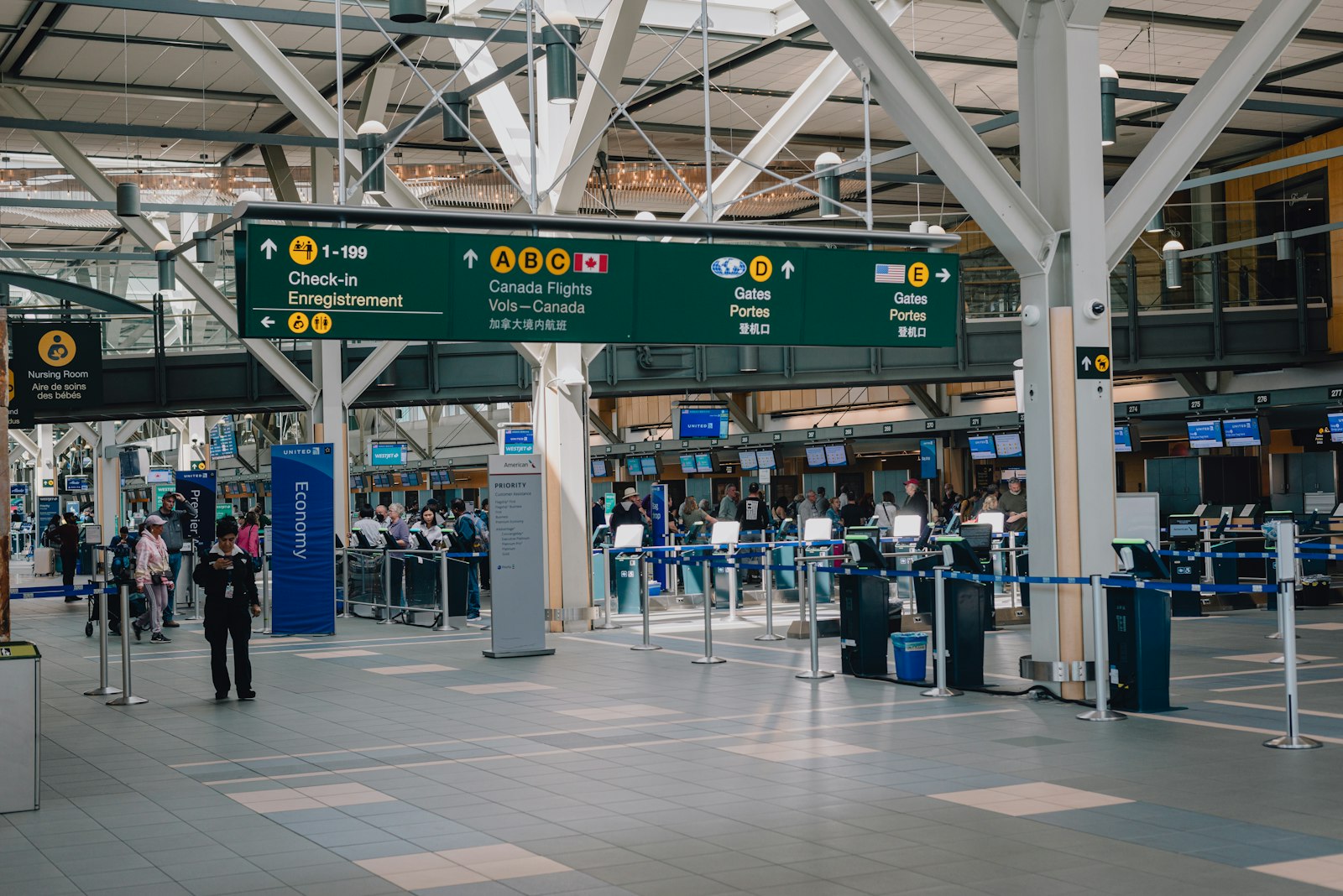
Wayfinding built into the floor
Large terminals are confusing by nature, and the people using them include first-time travelers, international passengers, families, and travelers with reduced vision or mobility. The FAA’s guidance on airport terminal planning notes that signage and wayfinding must be consistent and reliable throughout the facility given how diverse passenger demographics are, and that materials should be chosen to minimize maintenance.
Floors can carry part of that load. Because terrazzo is poured and ground in place, color fields, bands, and inlaid markers become permanent parts of the surface. A colored path leading from security toward a concourse, or a change in field color marking a transition between piers, guides people without requiring them to stop and read.
Unlike applied graphics or signage, a floor-integrated path cannot be knocked out of alignment, removed, or worn away, and it stays legible for the life of the floor.
The acoustic tradeoff
Hard floors come with an acoustic cost.
Airports need hard, easily maintained surfaces. But hard, smooth surfaces are acoustically reflective, and reflective surfaces increase reverberation, which works against announcement intelligibility in exactly the large open volumes terminals are built from.
The answer is not to avoid hard flooring but to handle acoustics deliberately elsewhere in the design, through ceiling treatments, baffles, wall panels, and public address system design, rather than expecting the floor to solve a problem it cannot solve. Design teams that address this early get better results than those that discover it after opening.
Where different materials fit in a terminal
Terminals rarely use one floor throughout. Typical distribution:
- Terrazzo in main circulation, check-in halls, concourses, and other high-visibility public spaces where traffic is heaviest and the floor is part of the architecture
- Tile in restrooms, wet areas, food service, and back-of-house spaces where moisture and cleanability drive the choice, specified to ANSI A137.1, including slip resistance for the conditions
- Natural stone in feature areas and signature spaces where the character of the material is the design point
- Polished concrete in service corridors, baggage handling, and operational areas
- Carpet in holdrooms and lounges, where acoustic absorption and comfort matter more than resistance to rolling loads
The transitions between them are worth planning carefully, since transitions are where floors most often fail and where rolling luggage announces every imperfection.
Airport flooring from David Allen Company
David Allen Company has installed flooring in airport and transportation facilities, including Will Rogers International Airport in Oklahoma City. Our terrazzo teams have earned more National Terrazzo and Mosaic Association Honor Awards for quality workmanship than all other terrazzo contractors in the Southeast combined, with more than 50 million square feet of terrazzo installed across commercial, institutional, and government projects, and a comparable record in tile.
Because we install terrazzo, tile, stone, underlayment, carpet and resilient flooring, and polished concrete, we can handle multiple scopes on the same terminal project, which keeps transitions and schedule coordination in one place.
Frequently asked questions
What flooring is used in airports?
Terminals typically use several materials: terrazzo in main circulation and public spaces, tile in restrooms, wet areas, and food service, natural stone in feature areas, polished concrete in operational areas, and carpet in holdrooms and lounges. The mix reflects the different demands of each space.
Why is terrazzo common in airports?
Terrazzo is seamless, handles rolling luggage and heavy traffic, allows wayfinding and graphics to be built into the floor, and can be refinished in place rather than replaced, which matters in a building that cannot close.
How long does airport flooring last?
It varies by material and by how the space is used. Terrazzo commonly lasts the life of the building and is refinished rather than replaced, and tile and natural stone can stay in place for decades. Carpet and resilient flooring are replaced on a planned cycle.
Can flooring be replaced in an operating terminal?
Yes, though it requires phased scheduling, containment, and usually off-hours work. The disruption involved is a strong argument for specifying long-life materials in high-traffic areas from the start.
Can wayfinding be built into an airport floor?
Yes. Terrazzo allows color paths, bands, and inlaid markers to be poured directly into the floor as a permanent part of the surface, which is why it is often used to help passengers navigate large terminals.